
A three-in-one prediction system for wet AMD treatment
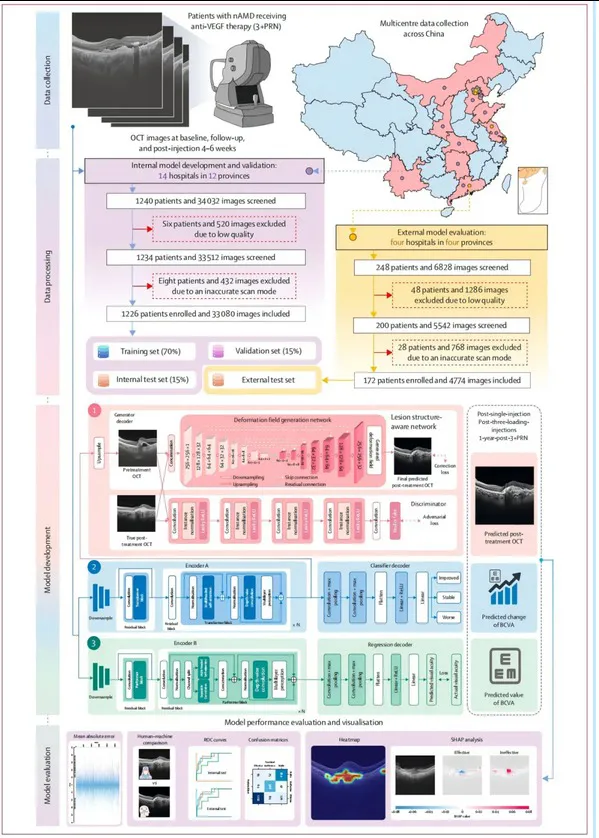
The “KongMing” model is a deep learning system built on a lesion-aware Transformer multi-task architecture. It was developed by PUMCH ophthalmologist Chen Youxin’s team with Sheng Bin’s team at Shanghai Jiao Tong University, using data from 18 tertiary hospitals across 12 Chinese provinces. The system performs three tasks: classifying whether visual function will improve, stabilise or worsen; predicting future visual acuity values; and generating expected post-treatment OCT scans. It covers three decision time points — after a single injection, after the three loading doses, and after one year of a 3+PRN regimen.
What the study reported
According to the report, KongMing’s vision-change predictions were more accurate than clinicians’, its visual acuity predictions had small errors, and its generated OCT images closely resembled real follow-up scans. It outperformed common baseline models across evaluation metrics. The model also flagged prognostic imaging features consistent with prior literature: choroidal neovascularisation, old scarring and intraretinal fluid were associated with poorer outcomes, while subretinal fluid was associated with better ones.
What it does not do
KongMing is decision support, not an autonomous decision-maker — treatment choices remain with ophthalmologists and patients. The published account describes model development and validation on collected data; it does not describe prospective trials of whether model-guided care leads to better vision outcomes, nor routine clinical deployment. Predictions are probabilities, not guarantees for any individual eye.
What comes next
The report suggests the model could help doctors and patients set expectations, adjust plans early when predicted response is poor, and avoid ineffective treatment. Prospective validation and integration into care pathways are the natural next steps, though the report does not state a timeline.
Relevance for patients
Neovascular age-related macular degeneration is a leading cause of vision loss in older adults, and China’s ageing population makes treatment capacity and personalisation increasingly important. This falls under Wellward China’s Eyes & Vision health area. This page is general information, not medical advice.