Dedicated institutions
TCM hospitals 中医类医院
China runs a complete tier of public TCM hospitals: 5,482 TCM-category hospitals nationwide. By 2025, TCM-category health institutions of all types exceeded 112,000.
In China's modern health system, "integrating Chinese and Western medicine" (中西医并重 中西医并重) is a statutory principle. Traditional Chinese medicine (TCM) is not an alternative sitting outside modern care — it is a formal, organic part of the national health system, guided by the logic of "use Chinese where Chinese fits, Western where Western fits, and let the two complement each other."
China's health system gives traditional Chinese medicine formal, co-equal standing with modern biomedicine — and builds clinical practice around the two working together.
The system is built on the principle of 中西医并重 — "equal emphasis on Chinese and Western medicine." TCM is not treated as a fringe or alternative complement; it is an organic component of the same public health system. Clinical decisions follow the idea of 宜中则中、宜西则西 (apply TCM where it fits, Western medicine where it fits), with Chinese and Western medicine complementing each other in diagnosis and treatment.
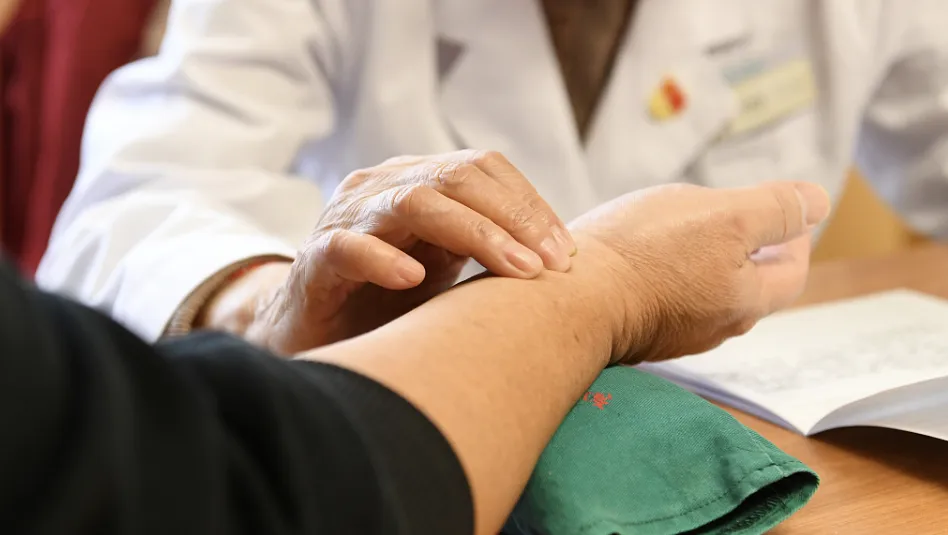
TCM is available through a complete, layered public network — not only in specialist hospitals.
China runs a complete tier of public TCM hospitals: 5,482 TCM-category hospitals nationwide. By 2025, TCM-category health institutions of all types exceeded 112,000.
96.26% of secondary-level and above comprehensive public hospitals operate a TCM department and a Chinese pharmacy — so a Western general hospital can directly provide acupuncture, tuina (therapeutic massage), herbal medicine and moxibustion.
Over 99% of community health centres and over 98% of township clinics offer TCM services; about 42,000 TCM pavilions have been built in grassroots facilities, bringing TCM physiotherapy and 调理 close to residents.
TCM practitioners are trained, licensed and regulated within a national framework — not as unregulated alternatives.
Both systems are used where each works best — and combined for complex or chronic conditions.
When a patient has persistent pain, sleep disturbance, fatigue, gastrointestinal dysfunction or menopausal discomfort — chronic symptoms Western medicine cannot quickly resolve — clinicians often recommend TCM external therapy or herbal medicine as a complementary plan. Many large tertiary general hospitals also run joint Chinese-Western multidisciplinary teams: for complex conditions such as tumours, rheumatological/autoimmune disease and chronic post-surgical recovery, Western and TCM doctors jointly design the plan — using modern imaging and laboratory tests for diagnosis, and adding TCM methods to ease pain, fatigue, insomnia and the side effects of chemo/radiotherapy.
For international patients, the integrated setup means two practical routes — and shared equipment for imaging.
You can choose a dedicated public TCM hospital. Or — within a tertiary general hospital's international department — receive a Western diagnosis and, on that basis, concurrent acupuncture, tuina and other TCM regulation. The two systems share the hospital's imaging equipment and laboratory, so an international patient can complete CT, MRI and other imaging studies and a TCM assessment in the same visit.
When international patients want dedicated traditional Chinese medicine — rather than TCM within a general hospital — these six hospitals are among the strongest in China. Each links to an international-patient guide with campuses, flagship specialties and practical notes.
No. 1 in the 2023 Academic Influence Evaluation of TCM Disciplines (Specialties); national No. 1 in TCM cardiovascular, spleen-stomach and geriatrics. A WHO Collaborating Centre for Traditional Medicine.
International Patient Guide →National No. 2 in TCM oncology (2023 specialty evaluation); strong in endocrinology and rheumatology, with renowned TCM tumour care and chronic-disease conditioning.
International Patient Guide →National No. 2 in TCM oncology; a national TCM clinical base with leading TCM surgery, orthopaedics (Shi's traumatology) and breast disease. A Shanghai international medical-tourism pilot.
International Patient Guide →National No. 1 in TCM orthopaedics (2023 specialty evaluation); TCM haematology and nephrology rank among the national top 10, at a national TCM clinical research base.
International Patient Guide →No. 2 in the 2023 Academic Influence Evaluation of TCM Disciplines (Specialties); national No. 1 in TCM dermatology and breast disease, with distinctive Lingnan acupuncture and moxibustion.
International Patient Guide →National No. 2 in TCM hepatology (2022 specialty evaluation), with top-10 nephrology and a national key encephalopathy department across a four-campus hospital.
International Patient Guide →The right route depends on whether you want a dedicated TCM hospital or integrated TCM within a general hospital's international department. Browse the hospital directory or contact us to discuss practical options.
Share your question, relevant records and intended travel timing. We can explain possible coordination steps.
Talk to a Concierge →